
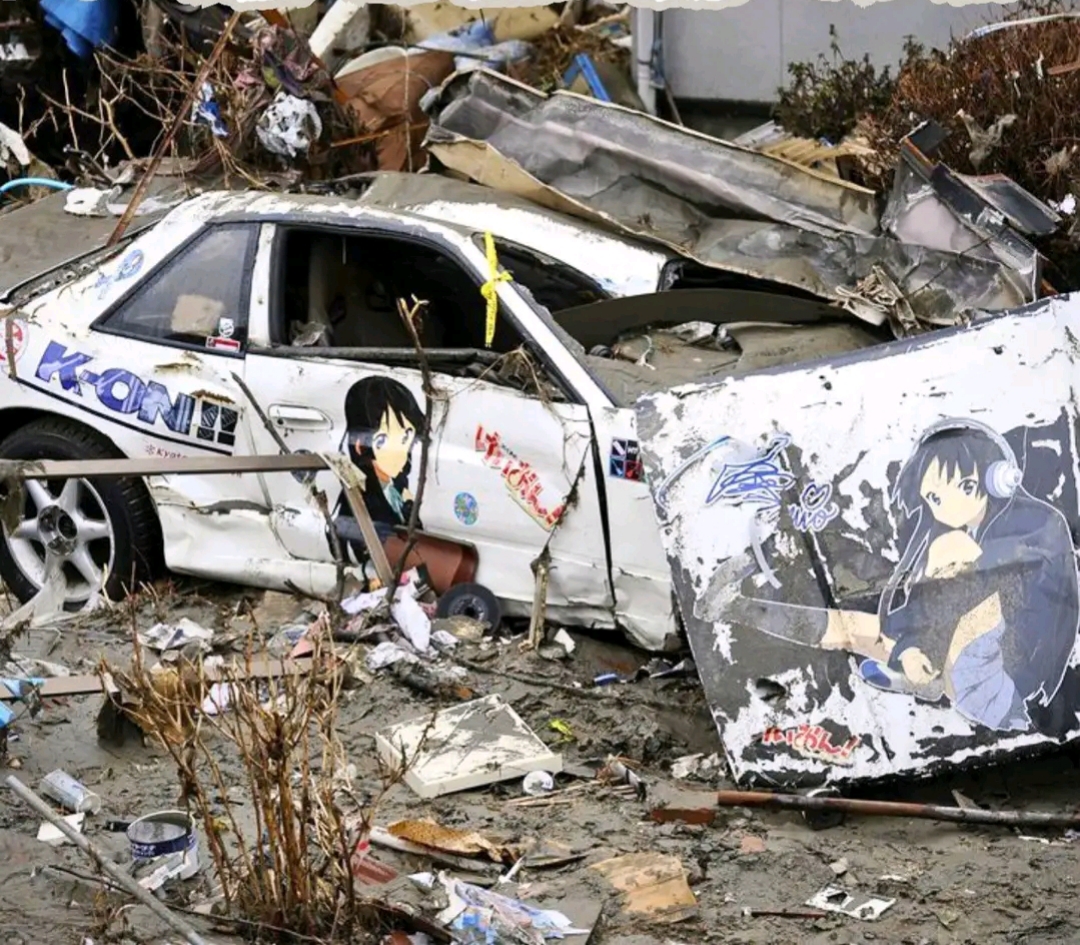
More than a decade after the 2011 Tohoku earthquake and tsunami, certain images continue to resurface—some not for their scale, but for the deeply personal stories they seem to carry. One such photo, shared again in anime fan communities, shows a wrecked white sedan covered in decals from K-On!, resting among debris left behind by the disaster. It’s a small, almost easily overlooked detail in the larger tragedy, yet it has struck a chord with many who encounter it.
The vehicle is an example of an itasha—a car decorated with anime characters, often customized with significant time, effort, and financial investment. These cars are rarely casual projects. For many owners, they represent a personal connection to a series, a visible expression of something that brings joy or meaning to their lives. Seeing one reduced to twisted metal amid disaster debris transforms it from a display of fandom into something far more sobering.
What has kept this image circulating isn’t just the visual contrast, but the questions it raises. Online discussions tend to shift quickly away from the car itself and toward the unknown story behind it. Who owned it? What did K-On! mean to them? Were they able to rebuild their life afterward, or did the disaster take more than just possessions? There are no clear answers, and that uncertainty is part of what gives the photo its emotional weight.
Fans often point out that an itasha is a commitment. It requires intention, care, and a willingness to share a passion openly with the world. In that sense, the car becomes a reflection of its owner’s identity—something personal made visible. When that identity is found among wreckage, it serves as a quiet reminder that every piece of fandom culture traces back to a real person with their own story.
The 2011 Tohoku earthquake and tsunami claimed thousands of lives and reshaped countless others. Images of destruction are not uncommon, but this particular photo resonates differently because of how specific—and human—it feels. It doesn’t just show loss on a massive scale; it hints at an individual life interrupted, a passion left behind in the chaos.
Over time, the image has taken on a kind of symbolic meaning within anime communities. It reminds viewers that fandom isn’t separate from reality—it exists within it. Behind every decorated car, every piece of merchandise, every shared enthusiasm, there is a person whose life extends far beyond that interest.
There’s no resolution to the story behind the car, and perhaps that’s why it lingers. Some images don’t need explanation to be powerful. They simply ask us to pause, reflect, and remember the people we’ll never know—but who, in their own way, were part of the same world.







Leave a Reply