
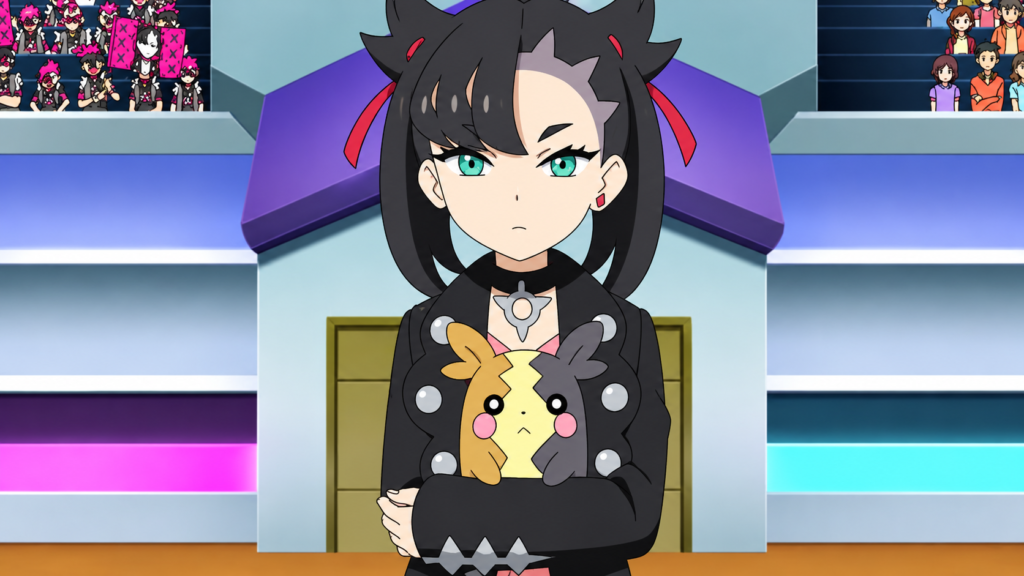
The seventh anniversary of Pokémon Sword and Shield has prompted several members of the development team to reflect on their experiences working on the games. Among them is character designer Yusuke Omura, who recently shared his thoughts on the initial reception of Marnie, one of the franchise’s most recognizable characters from the Galar region.
Although Marnie has since become a fan favorite, Omura recalled that her character design did not receive particularly strong attention when it was first revealed ahead of the game’s release.
In a social media post, Omura explained that Marnie only gained widespread popularity after players experienced the game and became familiar with her personality and role in the story.
He admitted that the experience left him with mixed feelings, adding that he would like to create a character who could attract attention through their design alone in a future project.
Marnie’s Popularity Becomes a Topic of Debate
Omura’s comments quickly gained attention on X, attracting tens of thousands of reactions and sparking discussions among Japanese social media users.
While Marnie is now widely appreciated by fans, with merchandise and fan artwork continuing to celebrate the character, some users questioned why her designer would publicly express disappointment over her initial reception.
Critics argued that Marnie is part of an established franchise rather than an entirely original creation owned by Omura. Some felt that publicly discussing the character’s early popularity could come across as dismissive of the collaborative nature of the project.
Others, however, viewed his remarks as an honest reflection of the expectations and ambitions that come with working as a character designer.
Fellow Character Designer Yusuke Kozaki Offers Support
The discussion also attracted a response from fellow character designer Yusuke Kozaki, known for working on the Fire Emblem franchise and other projects.
Kozaki expressed sympathy with Omura’s feelings, explaining that character popularity is often determined by factors beyond visual design. A character’s personality, motivations, and role within a game’s story can significantly influence how audiences respond after release.
However, Kozaki also pointed out that some characters become popular even before players experience the full story, demonstrating the impact a strong visual design can have on an audience.
As examples, Kozaki mentioned Tracer from Overwatch and 2B from NieR: Automata, whose designs helped establish strong interest in their respective games.
A Reflection on the Challenges of Character Design
Ultimately, the debate highlights the different expectations surrounding character design in the gaming industry. While some fans believe a character’s popularity should be judged through their overall contribution to a franchise, designers may also want their artwork to make an immediate impression.
For Omura, Marnie’s eventual popularity remains an achievement, even if it took players experiencing Pokémon Sword and Shield to fully appreciate the character.
Seven years after the games’ release, Marnie remains a memorable addition to the Pokémon universe, demonstrating how a character’s reputation can grow well beyond their initial promotional reception.
 Splatoon Raiders Gets Free Nintendo Switch 2 Demo With Three Playable Stages
 Digimon Alysion Confirms Global Release Regions as Pre-Registrations Surpass 400,000
 PS5 QSSR Upscaling Support Announced for Spider-Man 2, ARC Raiders, and More Games
Tinggalkan Balasan